
Fall 2026
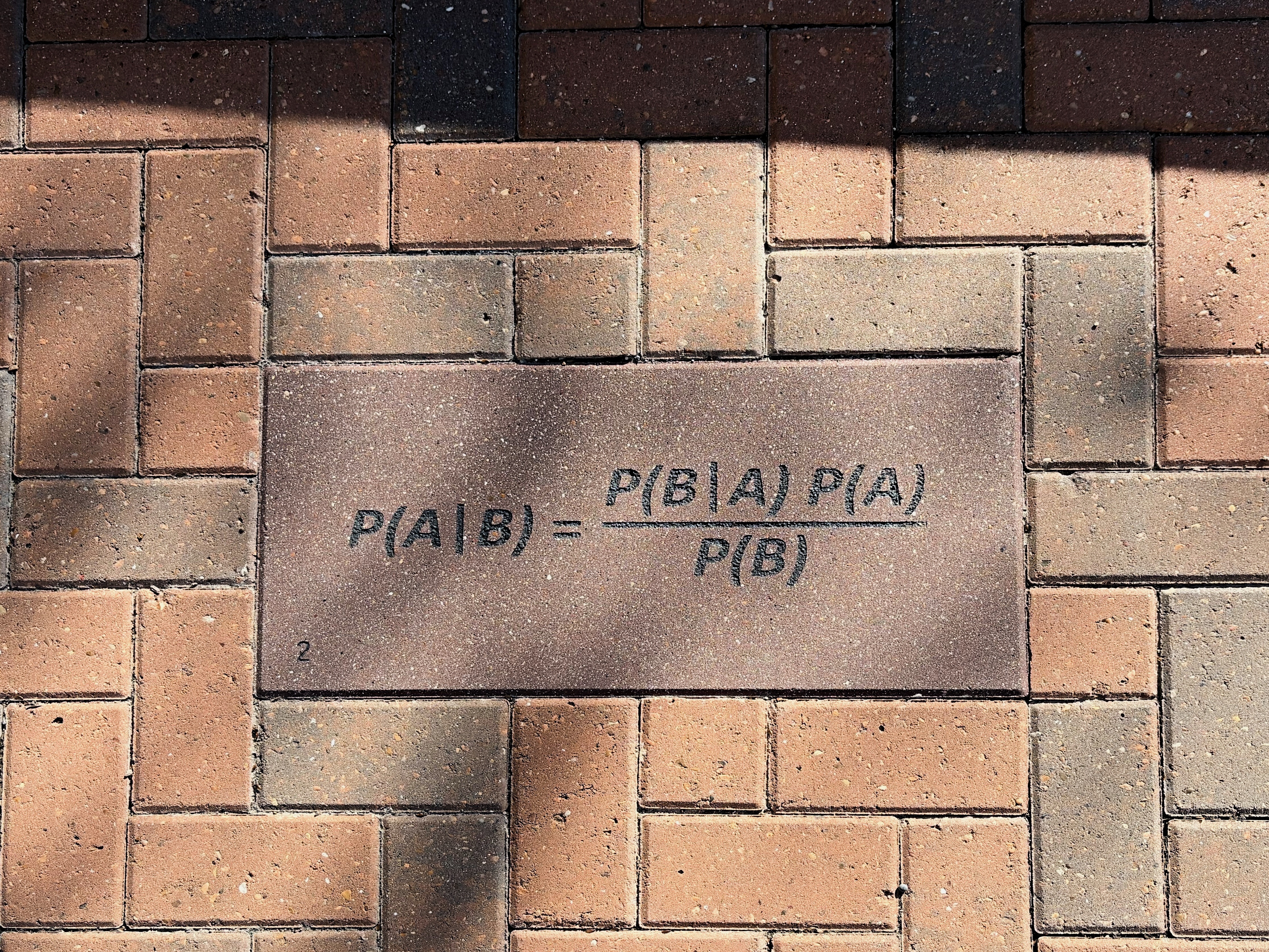
In this course we’ll learn how to model decisions, risk, and preferences using Bayesian inference. We’ll explore how to make choices under uncertainty and how those choices differ from rational models. Drawing from economics, psychology, and management science, we’ll apply these ideas to engineering systems.
This schedule may be updated as the semester progresses with all changes documented here (E-mail announcements will be made prior to any potential changes).
| Lecture | Topic | Chapter |
|---|---|---|
| 1 | Bayesian thinking for risk and decision analysis | Ch. 1 |
| 2 | Bayesian updating and evidence accumulation | Ch. 2 |
| 3 | Prior modeling and expert knowledge | Ch. 3 |
| 4 | Bayesian decisions and directed acyclic graphs (DAG) | Ch. 5–6 |
| 5 | Bayesian updating and uncertainty propagation | Ch. 7 |
| Exam 1: Bayesian foundations + computation | ||
| 6 | Bayesian simulation, MCMC, and computational Bayesian inference | Ch. 8 |
| 7 | Bayesian regression for risk modeling | Ch. 9 |
| 8 | Bayesian prediction and model comparison | Ch. 10 |
| 9 | Multiple regression and decision drivers | Ch. 11 |
| 10 | Bayesian count models and rare events | Ch. 12 |
| Exam 2: Predictive modeling + risk analysis | ||
| 11 | Bayesian classification and logistic risk models | Ch. 13–14 |
| 12 | Hierarchical Bayesian models | Ch. 15–16 |
| 13 | Advanced multilevel and structured uncertainty models | Ch. 17–18 |
| 14 | Bayesian decision analysis and probabilistic forecasting | Ch. 19 |
| Final project: probabilistic programming, risk communication |
"Risk comes from not knowing what you're doing." Warren Buffett
"Project success is not about avoiding risks but about making better decisions when they appear."
"It is not the strongest or the most intelligent who will survive but those who can best manage change and uncertainty." adapted from Charles Darwin
"Even one well-done observation will be enough in many cases, just as one well-made instrument often suffices for the establishment of a law." Émile Durkheim
Return home